Grand Finale of Green Future Innovation Challenge 2025 concludes successfully
24 Nov 2025
The Grand Finale of Green Future Innovation Challenge (GFIC) 2025 concluded successfully at the International Conference Centre of University Town of Shenzhen.
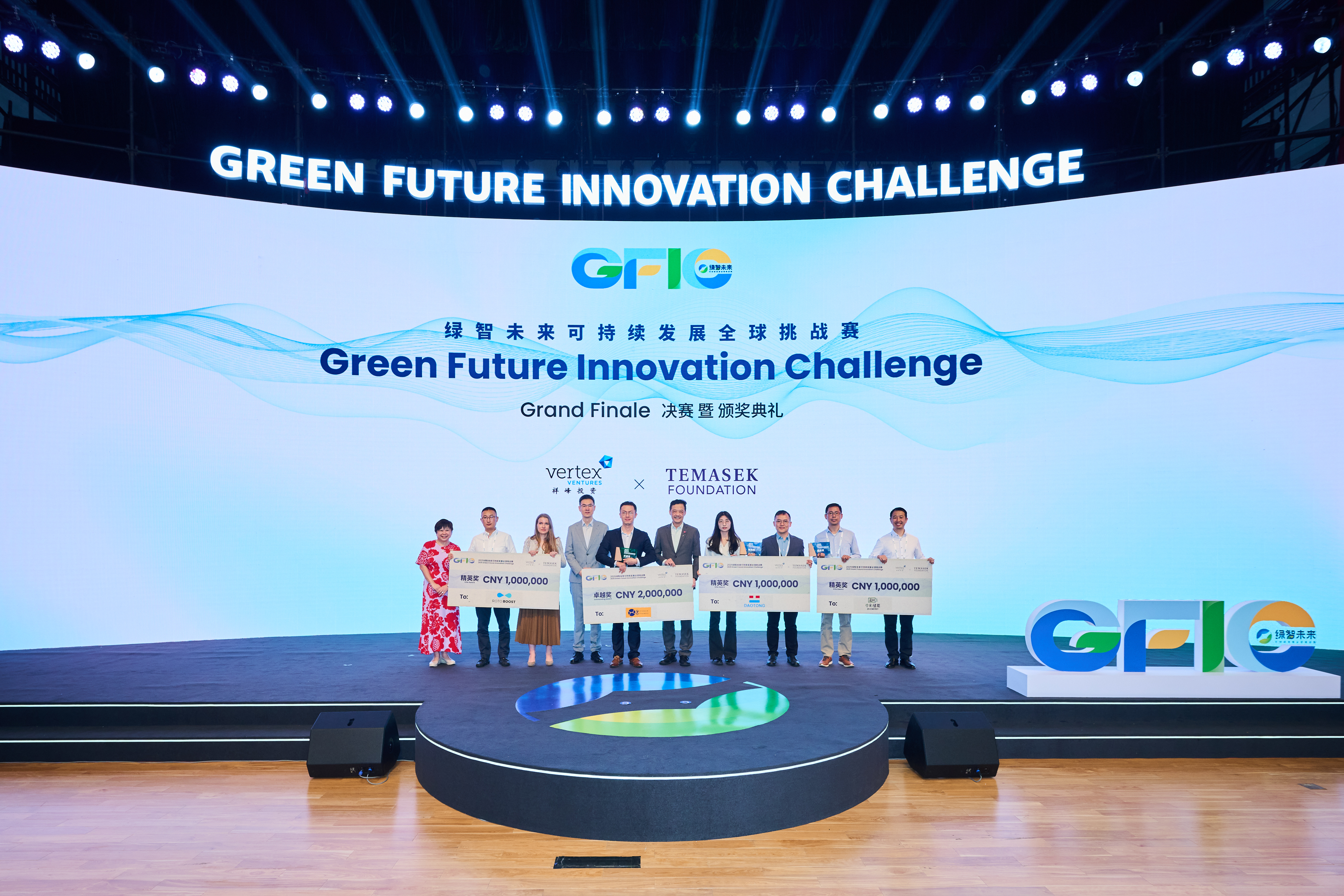
The Grand Finale was attended by distinguished guests including Ms Sim Ann, Senior Minister of State for the Ministry of Foreign Affairs and Ministry of Home Affairs, Member of Parliament, Singapore; Ms Zhou Suli, Deputy Chief of Mission and Minister-Counsellor of the Singapore Embassy in China; Mr Cai Danhong, Deputy District Mayor of Shenzhen Nanshan District People’s Government; Mr Tay Choon Chong, Founding and Managing Partner of Vertex Ventures China; Mr Quek See Tiat, Board Director of Temasek Foundation; Mdm Zuraidah Abdullah, Board Director of Temasek Foundation; Mr Ng Boon Heong, Executive Director and Chief Executive Officer of Temasek Foundation; Mr Zou Ji, Chief Executive Officer and President, Energy Foundation China; Mr Ma Weihua, Member of the United Nations Development Programme Sustainable Development Goals Impact Steering Committee and Chairperson of China Alliance of Social Value Investment (Shenzhen); Mr Li Junfeng, Venture Partner and Head of the Institute for Carbon Neutrality, HSG; and Mr Lui Xuejun, Executive Assistant to Chairman of Chairmen Office, Wei Chuan.
Leaders from Belt and Road Environmental Technology Exchange and Transfer Center (Shenzhen), Shanghai Municipal Commission of Economy and Informatization, Shenzhen Qianhai Financial Development Bureau Section also attended. Over 500 representatives from government departments, enterprises, industry associations, financial institutions, technology innovation platforms, academic institutions, and non-profit organisations witnessed this significant milestone event.
The Challenge was jointly organised by Vertex Ventures China and Temasek Foundation. It aims to identify sustainable solutions that are innovative and commercially viable, contributing to the achievement of global sustainable development goals. This inaugural Challenge focused on four key tracks: Industrial Decarbonisation, Energy Transition, Sustainable Agriculture, and Pollution Reduction. Since its launch on 23 April 2025, GFIC received over 1,000 submissions from around 70 countries and regions worldwide. After a rigorous evaluation by the Challenge’s review panel and thorough assessment through online roadshows, 10 projects successfully progressed to the Grand Finale.
At the Grand Finale, the shortlisted teams elaborated on the core advantages, potential to commercialise and scale, and implementation pathways of their green technologies through project pitches and interactive Q&A sessions with the judges. After an intense competition, Feyman Dynamics won the Outstanding Award and a prize of CNY 2,000,000; while Daotong New Energy, ROTOBOOST and ZH Energy were honoured with the Elite Awards and won CNY 1,000,000 each.
Among them, Feynman Dynamics is a deep tech start-up that has advanced technology for large-scale and cost-effective electrochemical production of sustainable aviation fuel that is able to reduce lifecycle emissions by more than 90 per cent compared to traditional jet fuel. Daotong New Energy has innovative technology for full recycling of retired lithium iron phosphate batteries, enabling the recovery of high-value materials. ROTOBOOST will implement a thermal-catalytic decomposition (TCD) technology pilot in China, in partnership with the world’s largest steelmaker Baowu. ZH Energy has breakthrough iron sulphur battery technology that can replace vanadium and lithium batteries for safe and cost-effective integration of renewable energy into the grid.
The event commenced with a special address by SMS Sim. She stated that the Challenge is a vivid embodiment of the long-standing and multi-faceted bilateral cooperation between Singapore and China, aligning closely with the consensus on green development cooperation. SMS Sim acknowledged China’s global role in the green transition and emphasised that climate change, as a global challenge, requires cross-border and cross-sector collaboration to jointly promote the implementation of scalable sustainable development solutions.
Subsequently, Mr Tay Choon Chong and Mr Ng Boon Heong delivered welcome speeches on behalf of the organisers.
Mr Tay highlighted the increasingly severe global climate crisis and noted that against this backdrop, China’s progress in advancing its green transition has been particularly remarkable. He stated that this Challenge aims to foster the deep integration of “Green” and “Technology” to solve core problems in sustainable development. Vertex China will provide multi-faceted support to the winning projects, leveraging China’s innovative strength to jointly build a sustainable and liveable “Green Intelligence Future.”
Mr Ng expressed that regional collaboration and technological innovation are key to driving sustainable development. China has demonstrated global leadership in the green technology sector, setting new benchmarks for carbon neutrality goals. The inaugural Green Future Innovation Challenge marks an important and promising start. Temasek Foundation will continue to work closely with partners in China and the region to collectively achieve the 2050 net-zero target, creating a greener future for generations to come.
During the keynote speech segment, Dr Ma Weihua pointed out that promoting the development of the climate technology industry has become a “mandatory choice” for the future. Philanthropic capital, serving as “patient capital” and “catalytic capital,” can help bridge the key financing gaps in the globalisation of the climate industry. He called for China and Singapore to join hands in advancing technology sharing, capital coordination, and market openness to move collectively towards a sustainable future.
Prof Qing Liu, Director of National Innovation Center par Excellence, elaborated on practical pathways for deepening the integration of technological innovation and industrial innovation. First, enhancing high-quality technology supply by building an innovation resource network and a “project manager system”-based scientific evaluation mechanism. Second, strengthening the dominant role of enterprises in innovation through precise connections with domestic and international R&D entities within the system. Third, efficiently promoting the transfer and commercialisation of scientific and technological achievements by exploring and implementing a full-chain support model covering “proof of concept – pilot scaling – commercial promotion”.
Prof Zou Ji, indicated that China’s economic growth and carbon emissions are gradually “decoupling”. He stated that green investment will become a crucial engine for economic growth, necessitating the construction of an integrated “Ambition – Technology – Investment – Financing – Policy” support system. Systematic mechanisms are needed to ensure the achievement of emission reduction targets and promote a steady and far-reaching green transition.
Dr Zhang Jun, Chief Economist and Head of Research of China Galaxy Securities, Deputy Chief Executive Officer of China Galaxy International, opined that while the artificial intelligence (AI) industry drives economic growth, the high energy consumption of data centres also poses challenges to the dual carbon goals. Leveraging the world’s largest renewable energy system already built, China provides green power support for the low-carbon operation of data centres. “AI + Green,” he argued, is constructing a unique long-term competitive advantage for China in the new round of technological revolution.
During the round table discussion titled “Frontier Technologies Driving New Opportunities in the Environmental, Social, and Governance (ESG) Sector,” Mr Feng Yecheng, Vice Dean of Yangtze Delta Region Institute of Tsinghua University, Zhejiang, stated that research platforms must provide “two-way empowerment” for cutting-edge university research and actual industrial needs. Ms Chen Yan, Deputy Secretary-General of Tencent Foundation, Founder of Tencent Tech for Good, believes AI is helping the public welfare industry achieve “the democratisation of professional capabilities” and “the restructuring of service models.” Mr Liu Xin, Chief Executive Officer of Shenzhen Starlink, emphasised that high-quality products must combine environmental technology, aesthetic design, comfort, and reasonable pricing. Dr Ma Zongming, Head of ESG Research & Chief ESG Analyst, China Galaxy Securities, suggested that making ESG a quantifiable and priceable factor of capital will be a key breakthrough point for future capital markets.
While the inaugural GFIC Grand Finale has concluded, the journey of green innovation will not stop here. Vertex China and Temasek Foundation will continue to leverage efforts to accelerate the industrialisation of green technologies, build a long-term, open, and win-win innovation ecosystem, and inject sustained momentum into the green transition for China and the world.